
Wildlife photography Tanzania safaris offer some of the most dramatic, species-rich shooting opportunities on the planet — and knowing how to make the most of them separates a good trip from a truly unforgettable one.
Here’s a quick-reference guide to get the best shots on a Tanzania photo safari:
| Goal | Best Location | Best Timing |
|---|---|---|
| Wildebeest river crossings | Serengeti (Mara River) | July – September |
| Calving season & predator action | Ndutu / Southern Serengeti | January – March |
| Black rhino & dense wildlife | Ngorongoro Crater | Year-round |
| Elephant herds & baobabs | Tarangire National Park | July – October |
| Lion prides & dry-season predators | Ruaha National Park | June – November |
| Bird photography | Serengeti & Ngorongoro | March – May |
Tanzania is not just another safari destination. It’s home to over two million large mammals in the Serengeti ecosystem alone, the world’s largest intact volcanic caldera at Ngorongoro, and some of Africa’s last truly wild landscapes. The light here — especially at golden hour across open savanna — is the kind photographers travel half the world to find.
But showing up isn’t enough. The difference between a blurry background shot and a frame-worthy image often comes down to when you go, where you position your vehicle, and what gear you bring.
This guide covers all of it — from the best parks and seasons to gear, guided safari options, and ethical practices that protect the wildlife you’re there to photograph.
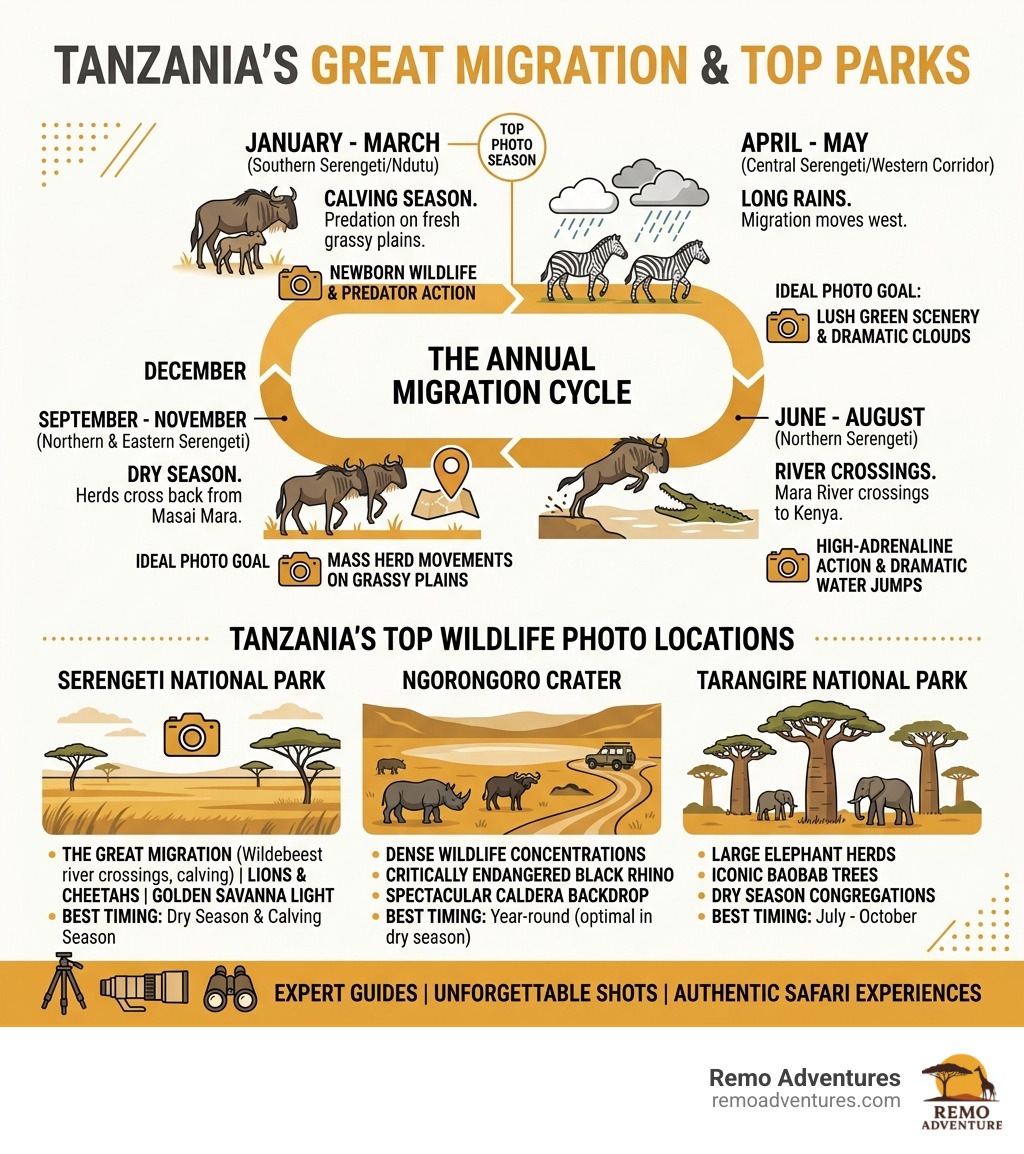
Choosing the right location is the first step toward a successful portfolio. Tanzania’s northern and southern circuits offer vastly different backdrops, from the volcanic walls of a crater to the rugged, baobab-studded landscapes of the south. We often recommend our 7 Days Wildlife Wonder Expedition for those who want a balanced introduction to these diverse habitats.
The Serengeti National Park is a behemoth, covering approximately 14,750 km². It is arguably the most famous wildlife photography destination on Earth, hosting over two million large mammals. For photographers, the draw is the sheer scale of the Great Migration.
In the Seronera Valley (Central Serengeti), big cat sightings are nearly guaranteed. Leopards drape themselves over sausage trees, and lion prides claim the granite kopjes (rock outcrops) as their thrones. If you are looking for high-octane action, our Serengeti Wildebeest Migration Safari positions you right in the path of the herds, where you can capture the “chaos” of thousands of animals moving as one.
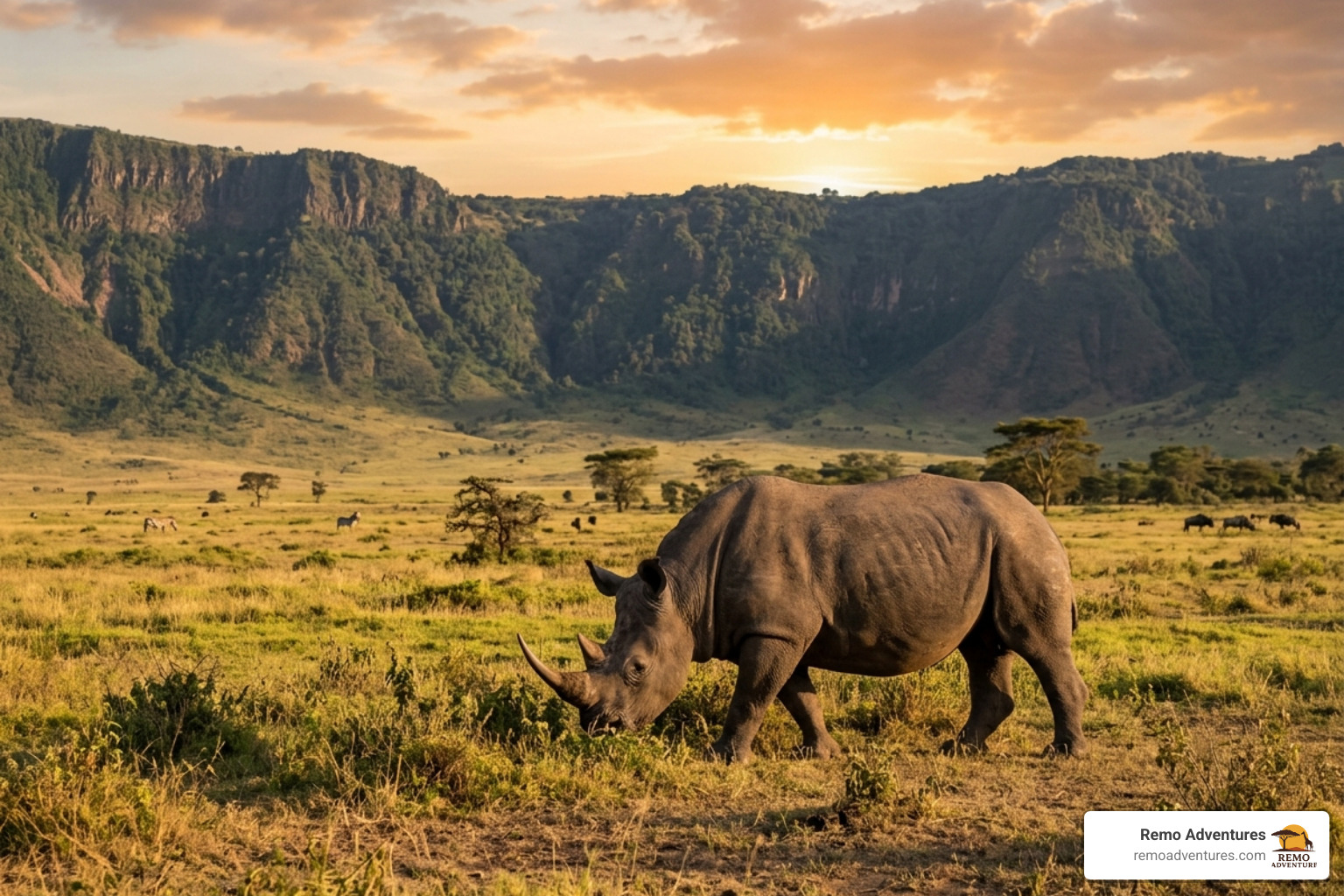
If the Serengeti is about scale, the Ngorongoro Crater is about density. This UNESCO World Heritage site is the world’s largest intact caldera, measuring 260 square km and 600 meters deep. Within this compact space live roughly 30,000 large mammals.
For photographers, the Crater offers a unique “amphitheater” effect. The steep walls provide a dramatic backdrop, and the morning mist often creates a soft, ethereal light that is perfect for flamingo reflections on Lake Magadi. This is also one of the best places in Africa to photograph the critically endangered black rhino. Because the animals here are relatively habituated to vehicles, you can often get closer than in other parks. A popular way to see this is via our 4 Days Serengeti to Ngorongoro route.
While the northern parks get the fame, the southern and central parks offer a “raw” Africa that is a dream for landscape and wildlife storytelling.
In wildlife photography, timing is everything. The Tanzanian landscape changes dramatically between the “Green Season” and the “Dry Season,” and animal behavior follows suit.
If you want to witness the circle of life in its most intense form, visit between January and March. This is the calving season in the Ndutu region (Southern Serengeti). Over 500,000 wildebeest calves are born in a matter of weeks.
For photographers, this means two things: tender moments between mothers and newborns, and high-intensity predator action. Cheetahs, lions, and hyenas are exceptionally active during this time. Our Serengeti Safari Tour during these months focuses on these interactions. Later in the year, from July to September, the action moves north to the Mara River for the famous river crossings, where wildebeest must brave crocodile-infested waters. This is the ultimate “action” shot.
From June to October, the vegetation thins out and water sources dry up. This is the peak time for predator photography. Animals congregate around the remaining waterholes, making sightings predictable.
The light during the dry season can be harsher at midday, but the “dust” kicked up by herds creates incredible atmospheric shots at sunrise and sunset. If you’re looking for a comprehensive trip that covers these conditions, the 12 Days Zanzibar to Serengeti Wildlife Wonders offers a great mix of bush and beach photography. For a shorter, high-impact trip, consider the 4 Days Wildlife Safari Expedition in Tanzania.
You don’t need to be a professional to take great photos, but having the right tools for wildlife photography Tanzania safaris makes a massive difference.
Wildlife is unpredictable. To freeze a cheetah in mid-sprint or a bird in flight, you need to master your settings:
For the best results, we suggest an all-inclusive approach like our Serengeti Safari All-Inclusive, where the logistics are handled so you can focus entirely on your settings.
Tanzania is dusty, especially during the dry season. Dust is the enemy of camera sensors.
Not all safaris are created equal. A standard tourist safari might rush from one sighting to the next to “check off” the Big Five. A photography safari, however, is about patience.
When booking through our Safari Holiday Packages, we prioritize:
A great guide is your most important “piece of gear.” Our guides at Remo Adventures understand that photographers need the sun behind them and the vehicle positioned before the action happens. They are experts in animal behavior; they can tell when a lioness is about to hunt or when a bird is about to take flight, giving you those precious extra seconds to prepare. Explore our specialized options at Tanzania Safari 2.
To truly diversify your portfolio, look beyond the standard game drive:
Wildlife photography comes with a responsibility to the environment and the animals.
Combining your safari with a trip to the coast can be a great way to relax after the intensity of the bush. Our Tanzania Safari and Zanzibar packages are perfect for this.
For full-frame cameras, a 200-600mm or 100-400mm zoom lens is the “gold standard.” It gives you the flexibility to shoot wide for environmental portraits and zoom in for tight headshots. A wide-angle (24-70mm) is also essential for landscapes and baobab shots.
Yes, especially on a crop-sensor camera where it behaves like a 600mm. In places like Ngorongoro, animals are often close enough that 400mm is plenty. However, for birds or shy predators in the Serengeti, you might occasionally wish for more reach.
Keep your camera in a closed bag when not in use. Use a “UV filter” to protect the front element of your lens. Never change lenses while the vehicle is moving or in high wind. If you have two camera bodies, keep a different lens on each to avoid changing them in the field.
At Remo Adventures, we believe that wildlife photography Tanzania safaris should be more than just a trip; they should be an immersion into the rhythm of the natural world. With our local expertise and personalized service, we ensure you are in the right place, at the right time, with the best possible angles to capture your “perfect shot.”
Whether you are aiming to document the Great Migration in 2026 or want to seek out the rare black rhinos of the Crater in 2027, our team is ready to craft an authentic, memorable experience tailored to your photographic goals.
Ready to fill your memory cards with the magic of Africa? Explore our Tanzania All-Inclusive Safari options and start planning your expedition today.
Tanzania Photo Safari: African Safari Photography Tours Photo Safari Tanzania, Wildlife Safari Tanzania Africa Nature Photography: Home